FIA Diecast 1962 to 1965
From 1962 to 1965, the FIA called the top series the International Championship for GT Manufacturers. Prototypes did race, but only at Sebring, LeMans, Nurburging and the Targa Florio. The GT championship was the only really important series, and Ferrari proudly dominated with their 250 GTO.
The GT class had several subclasses for different engine sizes, and for the overall championship the top class was for cars over 2.0 liters. But many events had further divisions, especially for 3.0 litre cars. While these extra subdivisions would be awarded class wins, the overall championship points were for all cars above 2.0 liters.
1962
Daytona Continental
Bill France staged a southern-fried World Championship event using the infield road course, thus inventing the "roval". Despite the cultural void between the somewhat-prissy Europeans, the event was well received, and would evolve into the famous 24-hour event.
Lotus 23 excluded from Le Mans
The Lotus 23 failed scrutineering at the last minute when it was discovered that the front and rear wheels had different bolt patterns. An enraged Colin Chapman left in disgust, vowing never to return...
This event is oddly relevant to the history of Can-Am racing. During these years the "Protoype" class was completely dominated by Ferrari, and much has been said about their ability to influence politics. The prototype class also had peculiar design requirements that mandated trunk space, spare tires, and other elements that did not necessarily increase performance.
So faced with a hostile environment in Europe, Lotus designed their next two-seater racing car to NOT comply with intenational rules. This car was the Lotus 30, and while it had its own problems, its presence and availability gave a huge boost to the concept of "Sports Racers".
|
Place |
Car
Sponsor |
Car # Class |
Model |
Ref. # |
Image |
| 4 | Ferrari 250 GTO
Giorgio Scarlatti 
Pietro Ferraro | 86
GT 3.0 | Box
| 8408 |  |
| 4 | Jaguar E-Type Spider (Hard Top)
Roy Salvadori  | 11
GT +2.0 | Best
| 9035 |  |
1963
1963 saw the arrival of the Shelby Cobra, the quintessential American sports Car.
Chevrolet also got into road racing by developing the Corvette 'Grand Sport'. While it looked like a normal corvette, this car was actually one of the first GTP's. It had little in common with the production version, and GM sold the 5 cars to top-level privateers.
|
Place |
Car
Sponsor |
Car # Class |
Model |
Ref. # |
Image |
| 1 | Ferrari 250 GTO
Graham Hill | 11
GT 3.0 | Box
| 8409 |  |
| 5 | Ferrari 250 GTO
David Piper | 16
GT 3.0 | Box
| 8403 |  |
| 1 | Ferrari 250 GTO
José Behra 
Pierre Noblet | 165
GT+2.0 | Bang
| 7291 | 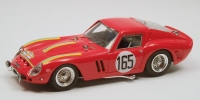 |
1964
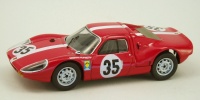
Porsche 904
The Porsche 904 was run early in the season in the Prototype class. Later it was homologated, and was then able to run as a GT car. It scored a crucial overall win at the Targa Florio, which broke Ferrari's longtime domination of major events.
This represents a major gap for collectors, as there have been few versions of these cars. Vitesse issued some nice Le Mans units, but went went out of business shortly thereafter. Ebbro released an item from the 1964 Japan GP, but there are many other more famous variations that would be more collectable. Minichamps has had a 'Daytona Continental' version listed for years, but so far there has been no sign of an actual model.
1965
The year 1965 was the end of the classic GTIII era. Shelby took the championship over Ferrari, who had abandoned the GT class to concentrate on prototypes. It was also the last year of the legendary Reims 12 hours, which began at 11PM and lasted through the night. The ruins of the pits, scoreboard, and grandstands are still on the side of the same country road in the beautiful Champagne reigon of France. The GT cars were road-legal, displayed license plates, and drove themselves to the event.
Prototypes also ran at Monza, and the manufacturers interest shown by Ford, Porsche, and Chevrolet prompted the FIA to include prototypes at all events in 1966.
Prototypes and Sports Racers...
Around this time, many American and British constructors began making two-seat cars that did not have the required design elements (trunk space, spare tires) that were required by the FIA "Appendix C" regulations. The American events had separate classes for the "Sports Racers" that would go on to be the backbone of Can-Am.