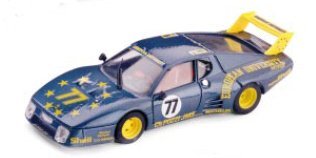
Ferrari 512 BBLM
"Sihlouette Racers"
When European sportscar rules were rewritten for 1976, there was a high-powered GT class called Group 5. This group was for production-based
cars that could be highly modified for racing. The key constraint was that the race cars should closely resemble the production versions when viewed from the side. This concept allows for wider tires and flared fenders while keeping much of the car's basic styling intact.
This idea has been done sucessfully by many racing series over the years, and the very popular Japanese GT Championship is a perfect example. Allowing race constructors to "slamm" a production car up to a common high performance is an attractive idea for both factories and sanctioning bodies. It allows different base cars to be equalized for close competition. Manufacturers like this concept because they are less likely to be completely dominated by a marketplace competitor. Thay also have a bit of political cover because the modifications are so extensive so as to make losing not seem to be the production cars's "fault". In the JGTC, this means that Honda, Nissan, and Toyota can race but poor performace reflects more upon the individual teams and not the Marque.
Back in the 1970's Porsche developed the seminal 935 for this FIA Group 5 sihlouette class. Ferrari did come back with a factory-built racing version of the 512 BB (that is, the 5-Litre, 12 cylinder Berlinetta Boxer).
Porsche has always had the ability to provide first-rate support to its race car customers. The white Porsche parts truck is such a fixture in racing it's almost invisible.
While Ferrari has developed many "turn-key" race cars over the years, it has not always been such a partner. The 512 BB/LM, like the Porsche 935, was a car that could be purshased and raced. But the continuing development, logistical support, and aftermarket upgrades (like the Kremer K3) simply did not exist.
So these Ferraris typically ran only at Le Mans, but had adequate performance and reliability to be right in the thick of things. If they had been a bit more practical they might have had a much richer racing history.
This car was run by the hard-core Ferrari GT racers, N.A.R.T., Charles Pozzi
Diecast
There are many versions of these cars available to collectors. Brumm has had their somewhat crude models for years, and then in 2005 IXO and Best put out new units.